
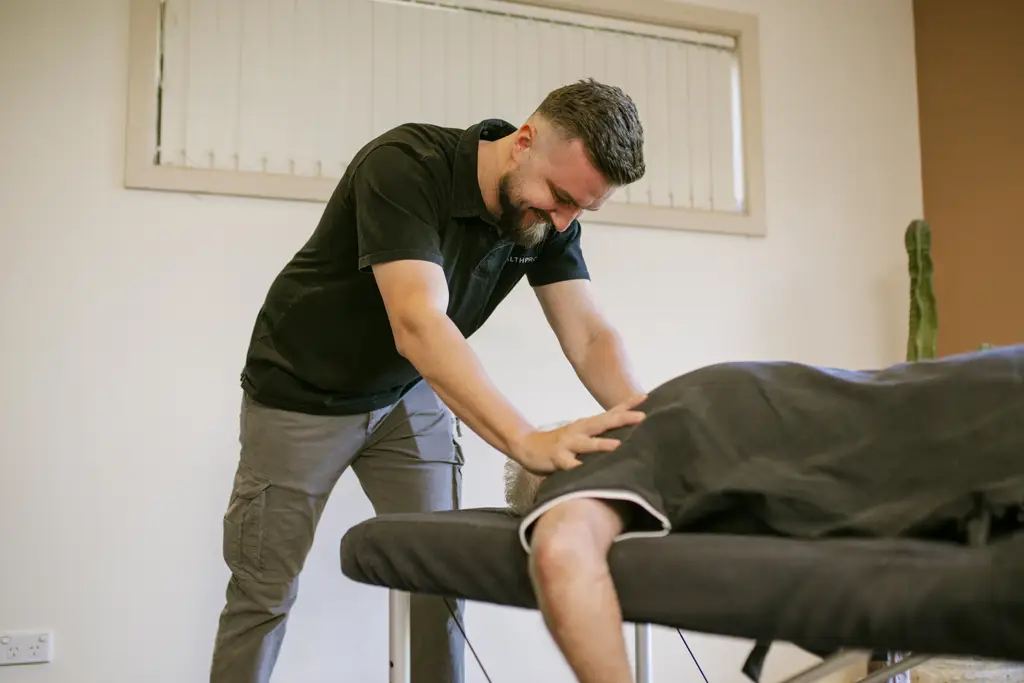
If you have had a stiff, aching neck for more than a few weeks, you have probably come across two terms: thoracic manipulation and cervical mobilisation. Both are hands-on techniques a physiotherapist might use, and both get talked about as though they are the fix. The honest picture is more useful than that, and knowing it helps you get more out of treatment. Healthproof provides in-home physiotherapy across Greater Sydney and Melbourne, so this is the conversation we have with clients on their own lounge room floor most weeks.
What “mechanical” neck pain actually means
Mechanical neck pain is pain that changes with movement and position. It tends to be worse after a long stretch at a desk or on a device, easier when you move around, and it often comes with a sense of stiffness or a limited turn to one side. There is no single damaged structure to point at. The joints, muscles, discs and nerves of the neck all share the load, and the surrounding shoulder blades and upper back share it too.
That last point matters, because it is the reason a physiotherapist may treat your upper back when your neck is the thing that hurts.
Thoracic manipulation, in plain language
Thoracic manipulation is a quick, small-range thrust applied to the joints of the upper and mid back. It is the technique that sometimes produces a popping sound, which is simply gas moving within the joint and is not a sign of anything being put back into place.
Physiotherapists use it for neck pain because the upper back and the neck work as one unit. If the thoracic spine moves poorly, the neck tends to take up the slack. Treating the stiffer region below often gives the painful region above a bit of room to move.
Cervical mobilisation, in plain language
Cervical mobilisation is gentler and slower. Rather than a thrust, the physiotherapist applies repeated, graded pressure to the neck joints, usually with you lying face down or on your back, working within a range you can tolerate. You stay in control throughout and can stop at any point.
It is generally the first choice for the neck itself, particularly for people who are sore, anxious about hands-on treatment, or managing other health conditions. It is also easy to do well in a home setting, which matters when the treatment is happening on your own bed or in your own chair.
What the research actually shows
Here is where it pays to be straight with you.
A systematic review and meta-analysis of eight randomised controlled trials, covering 457 people with chronic mechanical neck pain, found that thoracic spine manipulation produced a real but modest improvement. Pain fell by about 12 points on a 100-point scale, and neck-related disability improved by around 6 points on the Neck Disability Index. The authors rated the overall certainty of that evidence as low to moderate.
A 2025 umbrella review went a step further and assessed the quality of seven existing reviews on the same question, covering 27 studies and 1,394 people. Every one of those reviews pointed the same way, that thoracic manipulation is a reasonable short-term option. But confidence in those findings ranged from low to critically low, which means the technique looks helpful in the short term and the research is not yet strong enough to promise more than that.
The most recent Cochrane review on manual therapy combined with exercise, published in December 2025 and covering nine trials and 694 adults, found that the combination produced a large reduction in neck pain and a moderate improvement in function compared with no treatment at all. Compared with a sham treatment, function still improved moderately, but pain relief was small or absent.
Read together, those three bodies of evidence say something sensible. Hands-on techniques help, mostly in the short term, mostly with how well you move. They are a door opener, not the whole treatment.
Why exercise does the heavy lifting
Manual therapy buys you a window of easier, less guarded movement. What you do inside that window is what changes things over weeks and months. In practice that means graded neck and shoulder blade strengthening, range of movement work, and small changes to how you sit, sleep and carry things.
If posture is on your mind, it is worth reading our piece on whether better posture helps neck pain, because the answer there is also more nuanced than the usual advice to sit up straight.
Is it safe?
For most people with mechanical neck pain, yes. The Cochrane review found little or no difference in non-serious side effects between manual therapy with exercise and the comparison treatments. The side effects that do occur are usually short-lived treatment soreness, a mild headache, or brief light-headedness.
Part of the reason thoracic manipulation is popular for neck pain is that it lets the physiotherapist get a response without thrusting through the neck itself. A good physiotherapist will screen you first, explain exactly what they are about to do, and choose the gentlest technique that will do the job. If you would rather not be manipulated at all, say so. Mobilisation and exercise are a perfectly good path.
When neck pain needs a closer look
Hands-on treatment is not the right first step for everyone. See your GP promptly, rather than booking physiotherapy, if your neck pain comes with any of the following:
- Weakness, numbness or pins and needles spreading into an arm or hand
- Trouble with balance, walking or fine hand movements
- Pain that followed a significant fall, a car accident or a direct blow
- Unexplained weight loss, fever, or night pain that wakes you and will not settle
- Dizziness, visual changes, difficulty swallowing or slurred speech
- A history of cancer, osteoporosis, inflammatory arthritis or long-term steroid use
What this looks like in a home visit
A first appointment usually runs about an hour. Your physiotherapist takes a history, screens for anything that needs a doctor, and checks how your neck, upper back and shoulders move. If hands-on treatment is appropriate, they will do it there and then, and you will usually notice a change in how freely you can turn your head before they leave.
You then get a short home programme built around what you actually have at home and what your day looks like, not a generic sheet. Because we come to you, that programme can be set up in the chair you sit in and at the desk you use, which is a large part of why it tends to stick.
Healthproof supports clients through NDIS, aged care, workers compensation, DVA, Medicare care plans and private funding. If you are not sure which applies to you, our team can work it out with you.
Common questions
Does the cracking sound mean it worked?
No. The sound is gas moving inside the joint. Plenty of effective treatments make no noise at all, and a loud one is not a better one.
How many sessions will I need?
Most people with straightforward mechanical neck pain notice a difference within three or four sessions. If nothing has shifted by then, the plan should change rather than simply continue.
Can I have mobilisation without manipulation?
Absolutely. Tell your physiotherapist and they will work within what you are comfortable with.
Will I be sore afterwards?
Some people feel mildly achy for a day, in the way you might after unfamiliar exercise. It usually settles on its own. Anything sharper or longer-lasting is worth a phone call.
Getting started
If your neck has been bothering you for more than a couple of weeks, a physiotherapist can tell you fairly quickly whether hands-on treatment is likely to help and what else needs to happen alongside it. You can make a referral online, or call us on 02 9188 6442 and we will take it from there.
This article is general information and is not a substitute for individual advice. Please speak with your GP or physiotherapist about your own situation.